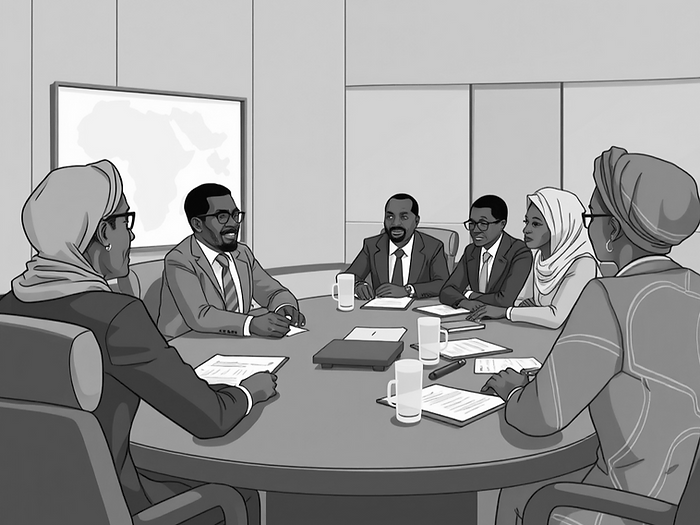
MORIM Insight
The awakened curriculum: when education stops importing and starts creating
By Affi Agbodo
The vast majority of curricula used in African higher education today were not designed in Africa. They were imported, translated, adapted at the margins — but their intellectual architecture remains someone else's. This is not necessarily a problem in itself: the circulation of knowledge is a genuine asset. The problem arises when importing becomes the only mode, to the point of stifling any local production of knowledge.
An imported curriculum naturally produces executors — professionals competent at applying frameworks designed elsewhere. It has a much harder time producing creators — professionals able to design new frameworks from the specific problems of their own context. Yet it is precisely this second capability that fast-transforming African economies need most acutely.
An awakened curriculum works the other way round: it starts from real local problems — agriculture, energy, health, governance, informal finance — and builds theory and method from those problems, drawing on the best international frameworks where relevant, without ever becoming a prisoner of them.
This approach fundamentally changes the learner's posture. It is no longer about memorising a model to reproduce it, but about developing the capacity to diagnose, adapt and sometimes invent an original response. It is a much harder skill to teach — and a far more valuable one for economies that must invent their own development trajectories.
MORIM designs its curricula on this logic: starting from the real needs of employers and partner institutions, building locally grounded case studies, and training teaching teams able to produce original content rather than simply transmitting imported content.
A continent's sovereignty is not only decided in its resources or its political institutions. It is also decided, quietly, in the classroom — in the choice to train executors of foreign models, or creators capable of inventing the solutions Africa needs.
Related articles
The university without a mission: why so many private institutions fail to produce useful graduates
Across Africa, the boom in private universities masks a crisis of relevance. When institutions prioritise enrolment over outcomes, they risk becoming diploma factories rather than engines of economic development.
The unclaimed legacy: when corporate expertise retires without a successor
How corporate expertise fades away without proper knowledge transfer, and the role of pedagogy in turning professional experience into a legacy that can be passed on.

What is education really for?
A questioning of education's fundamental purpose: has it become, above all, a form of ‘economic sorting' rather than a way of shaping responsibility and improving the world?
MORIM Insight
Ready to discuss this with our team?
A case for a curriculum rooted in solving local problems rather than applying global templates — shaping creators of local sovereignty, not just executors of foreign models.
Contact Us